Cameras are useful. They are not security. That distinction matters when a property owner in Riverside, Los Angeles, or Orange County is deciding where to put a security budget. A camera will give you footage to hand to police after a break-in. A licensed security guard will often make sure the break-in does not happen in the first place.
This guide walks through the real differences, with examples from properties we have actively protected, so you can decide what your business needs.
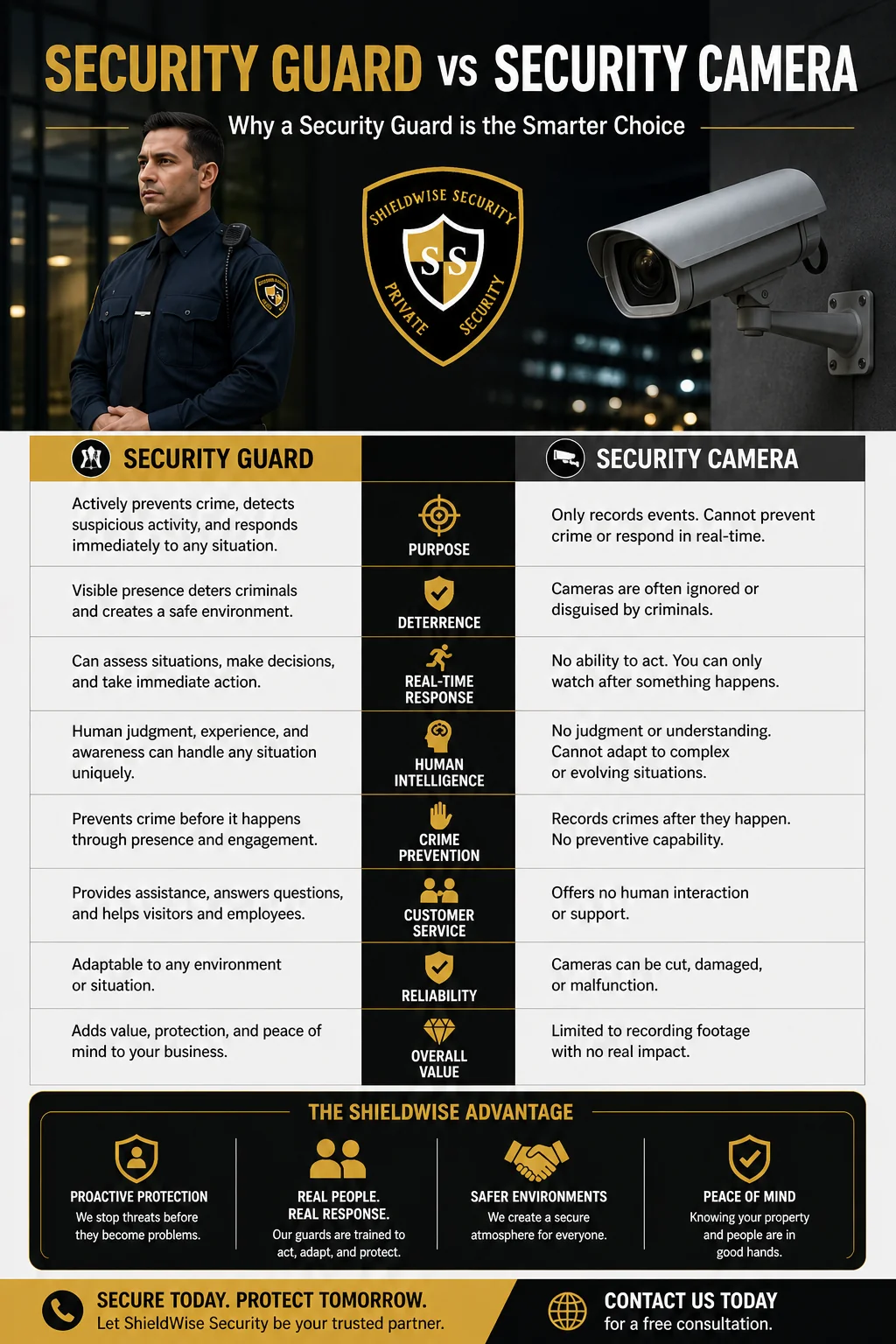
The Core Difference: Reaction vs Prevention
A security camera is a recording device. It captures footage that can be reviewed later. That makes it valuable for evidence and after-the-fact investigation, but it cannot stop a crime as it happens. Cameras do not make decisions, do not call for backup, and do not approach a suspicious person to ask what they are doing.
A security guard is a trained, BSIS-licensed person on site. A guard sees a problem developing and steps in. They call law enforcement, they document the incident in real time, and they often resolve the situation before it ever escalates to a crime.
Side-by-Side Comparison
| Factor | Security Guard | Security Camera |
|---|---|---|
| Purpose | Prevents crime, detects suspicious activity, responds in real time | Records events for later review |
| Deterrence | Visible uniformed presence that deters most opportunistic crime | Often ignored, disabled, or worked around by experienced criminals |
| Real-time response | Can assess, decide, and act on the spot | No response capability, playback only |
| Judgment | Human assessment of intent, context, and risk | No interpretation. A camera cannot tell a customer from a thief |
| Customer service | Helps visitors, answers questions, escorts staff | None |
| Reliability | Adapts to weather, lighting, power outages | Fails in fog, rain, glare, low light, or power loss. Can be cut, blocked, or stolen |
| Best fit | Active properties, after-hours sites, high-risk zones | Supplemental documentation alongside guards or alarms |
Where Cameras Fall Short
Cameras have specific weaknesses that property owners discover the hard way:
- Weather and lighting. Heavy rain, fog, glare, and low-light conditions can blur or wash out footage. We have responded to incidents in the Inland Empire where overnight footage was effectively unusable because of bright security lights washing out the image.
- Vandalism. Cameras themselves get stolen, spray-painted, or knocked offline. We have seen units cut from their mounts, smashed with bricks, or simply unplugged from an unsecured junction box.
- Network and power failures. A camera that loses internet connectivity, has a dead battery, or sits behind a router that has not been rebooted is recording nothing.
- Identification limits. Even clear footage of a stranger climbing a fence is often useless to law enforcement without a license plate, a clear face, or a unique identifier.
- No interaction. A camera cannot tell a homeless person to move along, ask a vendor for ID, or escort an employee to their car at midnight.
What a Guard Does That a Camera Cannot
Here are common scenarios where a camera alone falls short and a licensed guard makes the difference. None of these are hypothetical for property owners in the Inland Empire and Los Angeles area.
Cargo Theft on a Truck Yard
Transport yards face a common pattern: people cut through the soft sides of parked trailers overnight and pull out cargo. Cameras can record the activity for weeks without anyone being arrested, because by the time anyone reviews the footage, the cargo and the people are long gone. Overnight foot and vehicle patrol changes the equation. A visible uniformed officer making randomized rounds is the kind of unpredictable presence that opportunistic theft crews avoid. [Pattern observed across multiple Inland Empire logistics sites, speak with our team about your specific yard.]
Senior Center Trespassing
A senior community center with recurring after-hours intrusions can document every event with cameras and still not stop a single one. A live guard during high-risk hours adds the missing piece: a person who can confront an intruder, call police, or simply have a presence that turns the property into a less attractive target. Residents also benefit from the reassurance of knowing someone on site is paying attention.
Medical Office Lot, Trash Dumping and Loitering
Medical office properties in Riverside often deal with recurring dumping and loitering in their lots. Cameras show every incident clearly. The dumping does not stop because the people doing it know nobody is going to come outside. A marked patrol vehicle making randomized stops changes that calculation. The behavior moves elsewhere because the risk of being confronted is real.
Tenant Direct-Line Response
Multi-tenant properties benefit when every shopkeeper on the property has the patrol officer's direct number. A suspicious person, a blocked entrance, a confrontation in the parking lot, the tenant calls and an officer responds. That kind of two-way relationship is something a camera cannot provide, and it is one of the most effective ways to keep tenants confident in their lease.
When Cameras Make Sense
Cameras are not useless. They are simply not a replacement for a guard. Cameras work well when:
- You already have on-site or patrol coverage and want to document what happens between checks
- You need evidence for insurance claims or law enforcement after an incident
- You are protecting low-risk indoor spaces with controlled access
- You want to monitor employee or customer flow in a retail or office environment
The most effective security plans combine both. Guards prevent and respond. Cameras document and support investigations. Each layer covers the gaps in the other.
Cost: It Is Not Always What You Think
Cameras feel cheaper because the up-front cost is a one-time hardware purchase. The real cost picture is different:
- Camera systems require ongoing storage, monitoring software, internet bandwidth, replacement of damaged units, and someone to actually review footage. Without active monitoring, you only learn about incidents after the fact.
- Guard services price by the hour, but for many properties a part-time mobile patrol contract or split shift coverage costs less per month than expected. See our breakdown in the California Security Guard Cost Guide.
- Insurance and liability are part of the picture. Documented guard presence can support premises-liability defense and may affect how an insurer evaluates risk on a property, your broker is the right person to ask about specifics for your policy.
For many California properties, mobile patrol with documented timestamped reports is the most cost-effective option. It combines visible deterrence with after-the-fact documentation that insurers and law enforcement can actually use.
The Honest Bottom Line
If you can only afford one, choose the guard. A camera is a passive witness. A guard is an active deterrent. Cameras tell you what happened. Guards make sure less of it happens. For most California businesses, that is the deciding factor.
For high-value properties, the right answer is layered: a stationed or patrol guard for prevention and response, supported by cameras for documentation. Then alarms, lighting, and access control on top of that. Each piece doing what it does best.
Get a Free Site Assessment
ShieldWise Security (BSIS PPO #122008) provides licensed armed and unarmed guards, mobile patrol, and integrated security planning across California. We will walk your property, identify the gaps, and recommend the coverage that actually fits your risk and your budget. No pressure.
Request Your Free AssessmentSafety note: ShieldWise Security does not provide legal, medical, or emergency first-responder services. In an active emergency, always call 911 first.