Hospital & Healthcare Security in California
Emergency department coverage, workplace violence prevention support, visitor screening, behavioral health response, parking lot patrol. Trauma-informed officers under PPO #122008.
The emergency department at 2 a.m. is one of the hardest security posts in California. Patients arrive in pain, fear, and crisis. Family members arrive scared and ready to take it out on whoever's nearest. Behavioral health holds wait hours for placement. Drug-seeking visitors come and go. The officer working ED security has to hold composure while everyone around them is losing theirs, document everything in writing for clinical and legal review, and avoid escalating situations that are already volatile by their nature.
ShieldWise Security provides BSIS-licensed hospital security capability across California under PPO #122008. Our hospital coverage standard includes emergency department posts, hospital-wide patrol, behavioral health unit support, visitor screening, parking lot and garage patrol, and after-hours building access. Officers receive trauma-informed communication training, de-escalation protocols specific to healthcare environments, and orientation on California healthcare workplace safety standards before deployment. We staff for the post, not the contract, the officer assigned to a healthcare facility is selected for the role, not just dropped in to fill a schedule.
ED posts
Triage, waiting room, BH holds
Visitor screening
ID checks & access control
WVP support
Workplace violence prevention
Parking patrol
Staff escort & garage coverage
Important: Emergencies and 911
ShieldWise Security does not provide legal, medical, or emergency first-responder services. In an active emergency, always call 911 first. Hospital security officers are not paramedics, nurses, or physicians. In a clinical emergency, hospital staff lead the response and call additional resources as needed. Officers support the clinical team and secure the scene.
Coverage Scope
What Hospital Security Covers
The clinical environment shifts the security function from threat-focused to safety-and-de-escalation focused. Coverage scope reflects that.
Emergency department posts
Triage and waiting-room presence, patient-room support during agitated-patient situations, contraband screening at intake, behavioral hold supervision, visitor management at peak hours, and coordination with charge nurses on scene-control situations. ED security is its own discipline because the population, hour-of-day, and emotional intensity are all higher than general hospital posts.
Behavioral health unit support
Door access verification, transport supervision for involuntary holds under California Welfare and Institutions Code 5150, visitor screening for unit access, and crisis-response support when clinical staff request it. Behavioral health environments call for officers trained on trauma-informed communication and de-escalation that doesn't rely on physical control as the default.
Hospital-wide patrol
Floor-by-floor patrol on a documented schedule, public-area sweeps, restricted-area access verification, after-hours building checks, and responding to staff calls for assistance throughout the facility. Patrol officers know which units are highest-acuity and adjust route timing accordingly.
Visitor screening & access control
Main entrance check-in, ID verification, badge issuance for credentialed visitors, after-hours access management, and coordination with the hospital's visitor management system. Visitor restriction policies during outbreaks (norovirus, RSV surge, COVID waves) require fast operational adjustments, officers stay current on the policy of the week.
Parking lot & garage patrol
Staff-escort to vehicles after dark (a frequent request from night-shift nurses), patient-and-family parking lot patrol during ED peak hours, garage patrol for vehicle-break-in deterrence, and coordination with local PD when a parking lot incident requires their response.
Workplace violence response
California healthcare employers operate under a workplace violence prevention framework that requires documented incident reporting, ongoing training, and plan maintenance. Security officers support this framework operationally through accurate incident documentation, post-incident debriefs the hospital can use in plan revision cycles, and coordination with the hospital's safety committee on observed patterns. We support; we don't replace the hospital's prevention plan.
Forensic patient & prisoner-patient watch
For patients in custody (county jail transfers, parolees, suspects under arrest receiving treatment), county sheriff or local PD typically handles the actual custody. ShieldWise officers may support facility-wide coverage during these admits but don't substitute for sworn law-enforcement custody.
BH transport & discharge support
Coordinating with EMS or transport services on 5150 patient transfers, discharge support for patients without family or housing, and observation during waiting periods for behavioral health bed placement.
Sensitive event coverage
Active-shooter drills, infant abduction code drills (Code Pink protocols), bomb threat response support, and post-incident scene security. Drills happen on the hospital's calendar; we participate per the hospital's protocols and the security committee's direction.
For non-acute healthcare facilities, outpatient clinics, dialysis centers, ambulatory surgery centers, urgent care, coverage scales down from the ED-intensive baseline. The discipline doesn't change; the post intensity does.
Operational Realities
What Hospital Security Officers Are and Aren't
Three operational realities specific to healthcare.
Officers support clinical staff. They don't make clinical decisions. A nurse calls security to help with an agitated patient. The officer's role is presence, de-escalation support, and physical presence if a hands-on intervention becomes necessary at clinical staff's direction. The officer does not assess medical condition, make medication decisions, or determine whether restraint is clinically appropriate. Those are clinical decisions made by licensed clinical staff under hospital policy and California Department of Public Health regulations. We support; we don't lead.
Documentation quality matters more than incident frequency. California healthcare worker injury rates are among the highest of any non-construction profession, and hospital risk management departments review security incident documentation as part of their compliance and litigation defense work. The reports our officers produce are written to that standard, clear timeline, clear actions, clear outcomes, no narrative that creates exposure for clinical staff or the facility. Reports OSHA inspectors, plaintiff attorneys, or accreditation surveyors might read are written assuming they will be read.
De-escalation works in healthcare when force-first vendors fail. A security vendor that defaults to physical control and arrest as primary response causes more harm than good in clinical environments. Patients in pain, family members in fear, and behavioral health populations don't respond to authoritarian-style security. Trauma-informed communication, validation language, and physical de-escalation as a last resort are the standards. We hire and train officers for that approach. Vendors that send "tactical" officers to ED posts are delivering the wrong product.
Process
Our Hospital Security Process
Facility assessment with the security committee and clinical leadership
Before we quote, we walk the facility with the security committee chair (typically the chief of security, the COO, or the risk management director) and at least one ED charge nurse where access permits. The walk maps post placement against actual workflow, identifies blind spots, reviews the facility's existing workplace violence prevention plan, and aligns coverage with the facility's accreditation requirements.
Officer selection for healthcare-specific fit
Hospital posts get officers with strong communication skills, professional presence, and verifiable healthcare-environment experience or willingness to complete healthcare-specific training before first shift. New hires don't go to ED posts before training rotations on lower-acuity assignments.
Training before deployment
Officers complete documented training before first shift in any healthcare assignment: California healthcare workplace safety awareness, trauma-informed communication, de-escalation specific to clinical environments, 5150 hold familiarity, HIPAA awareness for officers (PHI minimization, what officers can and can't say in incident reports), and facility-specific orientation including code response protocols (Code Blue, Code Pink, Code Silver active shooter, facility-specific codes).
Daily activity reports plus structured incident documentation
Standard daily activity reports cover post mechanics. Hospital-specific incident reports are structured to feed the facility's compliance and risk-management documentation: who, what, when, where, who was injured if anyone, what de-escalation steps were attempted, what the outcome was, and what follow-up the security committee should consider. Reports are written same-shift while detail is fresh.
Quarterly security committee participation
We attend the hospital's security committee meeting quarterly (or more frequently if requested) to present trend data, surface observed patterns, and align upcoming coverage adjustments with the committee's priorities.
Compliance
Compliance and Officer Standards
BSIS standards apply to every officer, with healthcare-specific operational training added.
ShieldWise Security operates under California Private Patrol Operator License PPO #122008 issued by the Bureau of Security and Investigative Services (BSIS). BSIS Guard Card under Business and Professions Code Sections 7583.6 and 7583.7 applies to every officer assigned to a healthcare facility. That means the 8-hour Power to Arrest course before the first shift, 32 additional mandatory training hours within six months, and 8 hours of annual continuing education.
Healthcare-specific operational training (completed before first shift on any healthcare assignment):
- California healthcare workplace safety regulations, what they require, what officer documentation supports
- Trauma-informed communication standards
- De-escalation protocols for clinical environments
- California Welfare and Institutions Code 5150 (involuntary psychiatric hold) basic familiarity
- HIPAA awareness for non-clinical staff, minimum-necessary principle, incident report PHI handling
- Hospital code-response protocols (medical emergency, infant abduction, active threat, facility-specific)
- Restraint and use-of-force boundaries, what supports clinical staff vs what oversteps clinical authority
Armed officers at hospital facilities carry an Exposed Firearms Permit under Business and Professions Code Sections 7583.22–7583.23. Most California hospital security runs unarmed. Patient populations, clinical environments, and the specific dynamics of behavioral health holds and pediatric units don't generally support armed coverage. Armed coverage may be appropriate at facility perimeters, parking structures with documented incident history, or post-incident situations where the facility's security committee has approved armed response. The right configuration is typically determined during the assessment, weighing clinical risk alongside security needs.
Background screening:
- DOJ and FBI LiveScan fingerprint clearance
- Pre-employment drug screening
- Reference and employment verification
- Ongoing background monitoring per BSIS standards
- Healthcare-specific verification where required by facility policy (TB screening, vaccination compliance, drug screen panels matching hospital staff requirements)
Verification. Our PPO and any officer's current Guard Card status is verifiable on the BSIS license lookup. For California healthcare workplace safety, the California Department of Industrial Relations Cal/OSHA division publishes ongoing guidance and standards. The International Association for Healthcare Security & Safety (IAHSS) is the industry-standard resource for hospital security best practices, and informs our healthcare-specific training and post-order standards.
Coverage Model
Built Around Access Control and Clinical-Environment Response
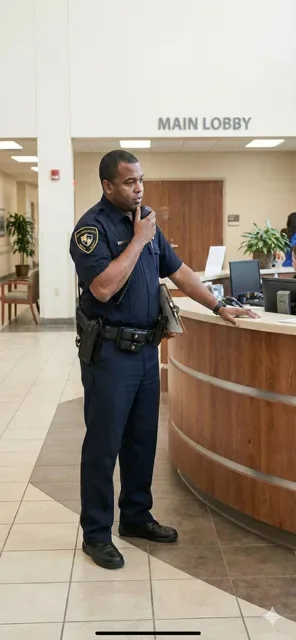
Hospital coverage centers on two recurring realities: entry points, visitor flow, and restricted units need consistent access control around the clock, and response inside a clinical environment has to be de-escalation-first rather than a generic security posture. Officers manage entry points and visitor verification, document incidents per facility protocol, and coordinate response with clinical staff and the security committee rather than acting independently of them. Coverage is configured around each facility's units, entry points, and code-response protocols.
Questions
Frequently Asked Questions
Honest answers to what hospital security committees and risk managers actually ask.
Hospital security in California typically covers emergency department posts, hospital-wide patrol, behavioral health unit support, visitor screening and access control, parking lot and garage patrol, and workplace violence response. The specific scope depends on the facility's size, acuity level, and security committee priorities. Most acute-care hospitals run 24/7 ED coverage plus daytime visitor screening. Outpatient clinics and ambulatory facilities typically run lighter coverage scaled to the actual clinical activity.
Yes. ShieldWise hospital officers complete healthcare-specific training before first shift in any healthcare assignment: California healthcare workplace safety awareness, trauma-informed communication, de-escalation specific to clinical environments, California Welfare and Institutions Code 5150 hold familiarity, HIPAA awareness for non-clinical staff, and facility-specific code response protocols.
Officers may support clinical staff in restraint situations at clinical staff's direction. The clinical decision to restrain is made by licensed clinical staff under hospital policy and California Department of Public Health regulations. Officers provide physical presence, support clinical staff during the intervention, document the incident, and stay clear of clinical decisions about medication, medical condition, or duration of restraint. Officers don't restrain patients on their own initiative or for security-only reasons.
Visitor restriction policies during outbreaks (norovirus, RSV surges, COVID waves, other infectious-disease management) require fast operational adjustments. Officers stay current on the policy of the week through morning shift briefings and posted updates from infection prevention. Specific procedures depend on the facility, some hospitals implement universal masking at entry, some restrict visitor counts per patient, some close visiting outright on affected floors. Officers enforce the current policy professionally without making exceptions that compromise the program.
Same baseline credentials and training, but behavioral health unit assignments require additional attention to trauma-informed communication, de-escalation that doesn't rely on physical control as default, and the specific dynamics of involuntary psychiatric holds under 5150. Officers assigned to behavioral health posts have lower physical-intervention thresholds and higher communication-and-presence standards. Force-first approaches don't work in behavioral health environments and create harm.
Most California hospital security runs unarmed. Patient populations, clinical environments, and behavioral health dynamics don't generally support armed coverage on the floors or in the ED. Armed coverage may be appropriate at facility perimeters, parking structures with documented incident history, or post-incident situations where the security committee has approved armed response. The right configuration is typically determined during the assessment, weighing clinical risk alongside security needs.
Day-to-day operations run through the chief of security or designated point of contact. Strategic coordination, coverage configuration, plan alignment with the facility's prevention framework, post-incident review, runs through the security committee. Incident reports go to the security committee chair and risk management on a documented cadence. We attend the security committee meeting quarterly or more frequently when requested.
Request Hospital Security Coverage
Most hospital security calls come from one of three places: a security committee evaluating coverage ahead of an annual plan review, a risk management director responding to a serious incident or injury claim, or a hospital administrator switching vendors after a documented coverage failure.
Licensed, bonded, and insured under California law. License verifiable on the BSIS license lookup. Certificate of Insurance available on request.
Last updated: April 2026.