Commercial Security for California Offices & Warehouses
Lobby presence, access control, after-hours patrol, and tenant-experience standards your property managers actually want representing the building. PPO #122008.
The first person a tenant interacts with in your building isn't the property manager. It's the security officer at the lobby desk. That officer is the building's customer experience for everyone who works there, every visitor who walks in, every delivery driver who shows up at the dock, and every after-hours contractor who needs access. If the officer is professional, attentive, and clear in their communication, the building feels managed. If the officer is checked out or curt with visitors, the building feels neglected, regardless of what your property manager is doing behind the scenes. Commercial security is brand work as much as it is risk work.
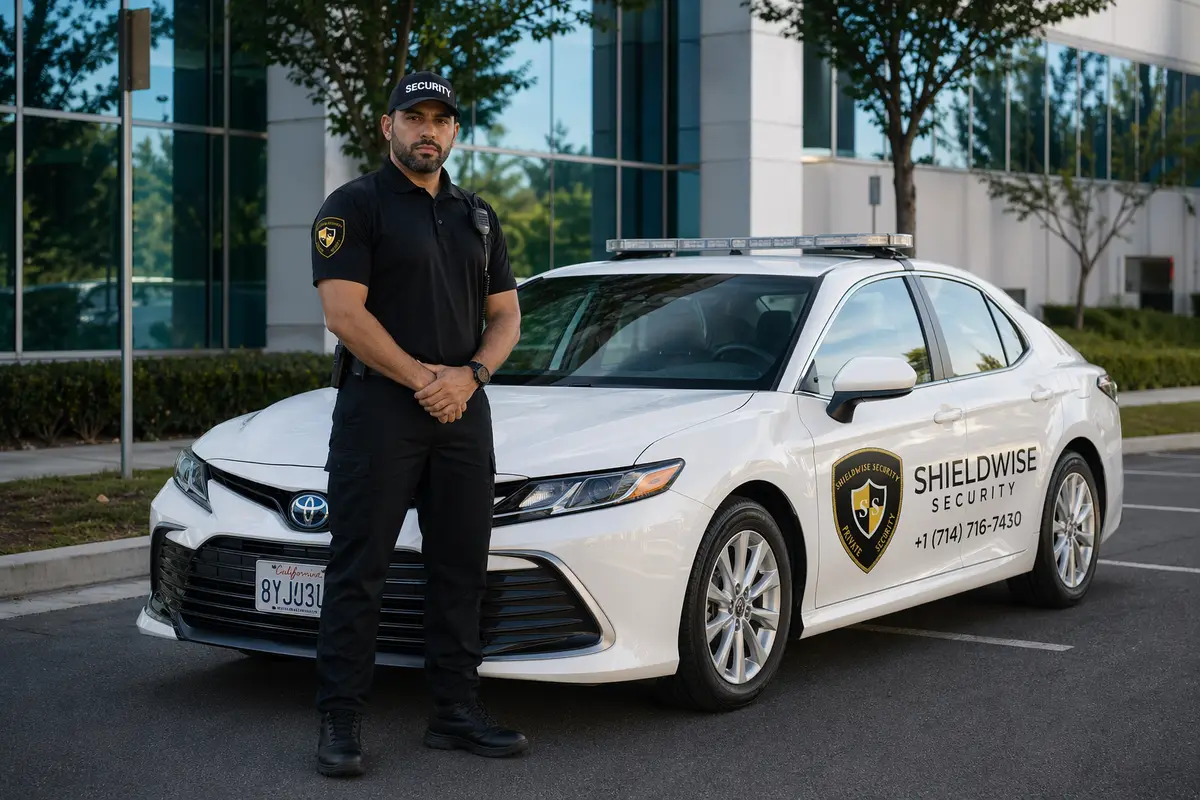
ShieldWise Security provides BSIS-licensed commercial security across California under PPO #122008. We staff offices, multi-tenant buildings, warehouses, distribution centers, mixed-use developments, and corporate campuses. The officer assigned to your lobby is selected for the role, trained in communication skills and professional presentation, and prepared to handle frustrated tenants without escalating, not just dropped in to fill a schedule. Day-to-day post orders are written with your property manager. Coverage gets adjusted as the building's tenant mix and operating hours change. We earn the renewal each month.
Lobby reception
Visitor management & check-in
Access control
Badge, PIN, biometric ops
After-hours patrol
Floor sweeps, dock checks
Tenant-interaction reports
To property manager daily
Important: Emergencies and 911
ShieldWise Security does not provide legal, medical, or emergency first-responder services. In an active emergency, always call 911 first. Our commercial security officers coordinate with law enforcement, EMS, and your building's fire safety director, but they are not a substitute for those services.
Property Types
Properties We Cover
The discipline is consistent across property types. The post placement, tenant profile, and operational rhythm aren't.
Class A office buildings and corporate towers
Lobby reception with concierge-style visitor management, badge and credential checks, after-hours tenant access verification, freight and loading dock coordination, parking validation support, and floor-by-floor evening sweeps. Officers represent the building to executive tenants and Fortune-list visitors. The hiring bar for officers assigned to these posts is higher than for general patrol.
Multi-tenant office buildings
Lobby presence, tenant directory and visitor logging, after-hours access for individual tenant codes, package and delivery management, common-area patrol. The challenge is balancing service across tenants with different expectations, a law firm wants quiet professional discretion; a tech startup wants minimal friction for late-night work and visitor flow. Post orders accommodate both.
Warehouses and distribution centers
Gate access for trucks and trailers, employee access verification, dock-area patrol, after-hours building checks, theft and shrink documentation, and coordination with operations supervisors. California warehouse security has its own operational rhythm because the building is busy through 11 p.m. or later in many cases. Post orders address the actual hours of activity.
Distribution and 3PL fulfillment facilities
Vendor and driver check-in, sealed-load verification, parking and trailer-yard patrol, perimeter walks, and incident documentation for shrink claims. Insurance carriers for 3PL operators increasingly want documented overnight presence, which is why we do this work in writing on documented post orders.
Mixed-use developments
Coverage that handles three different tenant types simultaneously: ground-floor retail with closing-time concerns, office floors with after-hours access, and residential units with different security expectations than commercial tenants. Mixed-use post orders specify which tenant type the officer is supporting at each hour of the shift.
Corporate campuses and tech offices
Multi-building campus security with shuttle coordination, employee badge access, visitor management for product launches and customer visits, parking management at scale, and after-hours patrol. Tech campuses often want a lighter visible footprint than traditional office buildings, which we accommodate while still meeting documentation standards.
Manufacturing and light industrial
Shift-change access management, contractor and vendor sign-in, perimeter patrol, dock supervision, and coordination with plant operations. Manufacturing security blends into the operations rhythm rather than overlaying it.
Adjacent services
For retail-only properties, see shopping center security. For apartment and HOA work, see apartment security and HOA security. For events at commercial venues, see event security.
Operational Reality
What Tenants Notice (and What Property Managers Should Care About)
Three operational realities specific to commercial security.
Staffing for the lobby is different from staffing for an industrial gate. The officer at your Class A lobby is the building's first impression. The officer at your warehouse dock is a logistics function. Both are licensed BSIS officers, but the priorities for each post are different, communication skills, professional presence, and language fluency for the lobby; equipment knowledge, dock-flow familiarity, and physical readiness for the warehouse. We staff for the post, not the contract.
Tenant complaints about security are usually about communication, not capability. "The new guard didn't know who I was" or "the lobby officer was rude to my client" or "no one returned my access call after 9 p.m." Most commercial security complaints fall into communication gaps, not coverage gaps. Our daily activity reports flag tenant interactions specifically so property managers see them before complaints escalate.
Coverage gaps in commercial security usually come from schedule transitions. Friday-to-Monday weekends. Holiday weeks. Shift changes during major maintenance work. The handoff between shifts is the moment most coverage failures happen, the outgoing officer assumes the incoming officer knows about the contractor on the third floor; the incoming officer doesn't; the contractor leaves without checking out and triggers an alarm at 11 p.m. We document handoffs in writing, every shift, every property.
Our Process
Our Commercial Security Process
Five steps from property walk to quarterly review.
Property assessment with the manager
Before we quote coverage, we walk the property with whoever runs it day to day. Where appropriate and the property manager allows, we also briefly meet with an anchor tenant. The walk maps lobby flow, after-hours entry points, dock and freight operations, parking access, alarm systems, and the rhythm of the building's actual workday.
Coverage configured to building rhythm
A 9-to-5 office tower needs different coverage than a building with after-hours legal and finance tenants. A warehouse running double shifts needs different coverage than a 6 a.m.-to-2 p.m. distribution center. We design hours and post placement around the actual operating rhythm.
Officer selection for the post
Lobby and reception-style posts get officers with strong communication skills and professional presentation. Warehouse and dock posts get officers selected for operational fit. New hires don't get assigned to anchor-tenant lobbies until they've worked through training rotations.
Daily reports + tenant tracking
Standard daily activity reports document the shift mechanics, walks completed, visitors logged, deliveries handled, incidents flagged. Commercial-property reports add a tenant-interaction line: which tenants were assisted, what was the nature of the interaction, did anything need property-manager follow-up.
Quarterly review with manager
Every quarter we sit down with the property manager, in person or by video, to review activity reports, tenant feedback, incident trends, and whether coverage still fits the building. Tenant turnover changes the building's rhythm.
Compliance
Compliance and Officer Standards
BSIS standards apply to every officer, with commercial-specific operational training added for lobby and access-control work.
ShieldWise Security operates under California Private Patrol Operator License PPO #122008 issued by the Bureau of Security and Investigative Services (BSIS). BSIS Guard Card under Business and Professions Code Sections 7583.6 and 7583.7 applies to every officer assigned to a commercial property. That means the 8-hour Power to Arrest course before the first shift, 32 additional mandatory training hours within six months, and 8 hours of annual continuing education.
Commercial-specific operational training:
- Customer service and tenant interaction standards
- Visitor and delivery management protocols
- Access control system familiarity (key card, PIN, biometric)
- Emergency evacuation procedures and coordination with the property's Fire Safety Director where one is designated
- Incident documentation standards for property-management reporting
- De-escalation in tenant disputes and visitor refusals
Armed officers at commercial properties carry an Exposed Firearms Permit under Business and Professions Code Sections 7583.22–7583.23. Most California commercial security runs unarmed because the property's tenant profile, brand expectations, and risk profile don't support armed coverage. Class A office towers, mixed-use residential floors, retail-tenant common areas, and corporate campuses are typically unarmed environments. Armed coverage may be appropriate for distribution facilities with high-value cargo, multi-tenant buildings with cash-handling tenants, or properties with documented security incidents that justify it. We tell you which configuration fits during the assessment.
Background screening:
- DOJ and FBI LiveScan fingerprint clearance
- Pre-employment drug screening
- Reference and employment verification
- Ongoing background monitoring per BSIS standards
Verification. Our PPO and any officer's current Guard Card status is verifiable on the BSIS license lookup. For property-management standards, BOMA International and BOMA Greater Los Angeles publish operational guidance that informs how we structure post orders for Class A and B properties.
Coverage Model
Built Around After-Hours Lockup and Multi-Tenant Access
Commercial coverage centers on two recurring realities: buildings empty out and lock down after hours, and multi-tenant properties require access managed at the suite level, not just the lobby. Officers secure entry points and perform lockup verification once tenants clear out, log which suites and common areas were checked, and coordinate visitor and vendor access with property management rather than treating every tenant's foot traffic the same way. Coverage hours and post placement are configured around each building's actual occupancy pattern.
Questions
Frequently Asked Questions
Honest answers to what property managers actually ask.
Commercial security work blends risk management with tenant experience and brand representation. The officer at a Class A office lobby isn't just a deterrent presence, they're the building's first interaction for every tenant, visitor, and vendor. That changes the staffing priorities, the training, and the day-to-day operational rhythm compared to a generic security post. Commercial post orders address tenant communication, visitor management, after-hours access, dock and delivery coordination, and property-manager reporting cadence in ways that general security doesn't.
That depends on the property type and tenant profile. Class A office buildings with high-value tenants typically run 24/7 lobby coverage as a brand and risk standard. Warehouses and distribution centers with extended operating hours often need coverage during the active hours, not the empty hours. Smaller multi-tenant buildings may only need after-hours patrol with daytime concierge coverage. We recommend a configuration after the property walk based on the actual building rhythm, not a default schedule.
Every BSIS-licensed officer carries the same baseline credentials, guard card, Power to Arrest training, LiveScan clearance. The differentiation is post-specific. For Class A lobbies and anchor-tenant interactions, we prioritize officers with strong communication skills, professional presentation, and language fluency where the tenant base requires it. For warehouse and dock posts, we prioritize officers with operational familiarity, equipment knowledge, and physical readiness. New hires don't go to high-visibility lobby posts before training rotations on lower-stakes assignments.
Recurring commercial security is the building's day-to-day baseline coverage, lobby, access control, after-hours patrol, tenant support. Event security is short-duration coverage for a specific event happening on the property: an open house, a launch event, a corporate gathering, an annual meeting. Events sometimes layer on top of recurring commercial coverage; sometimes they're separately scoped. We can quote either or both. See event security for short-duration event work.
Officers are trained on the building's access control system, key card readers, PIN pads, biometric scanners, intercom systems, to handle routine tenant and visitor access. For system malfunctions or technical failures, the officer documents the issue and escalates to the property manager and the access control vendor. Officers are not access control technicians. Our role is operating the system correctly and documenting issues, not repairing them.
Yes. For high-rise and high-occupancy commercial buildings where a Fire Safety Director is designated, we coordinate with the FSD on emergency procedures, evacuation drills, and post-incident reporting. Officers receive site-specific FSD coordination training before being assigned to qualifying buildings. Emergency procedures stay the FSD's responsibility; we support them operationally.
Commercial security pricing depends on coverage hours, post type (lobby, patrol, dock, multi-post), property size, tenant profile, and whether armed coverage is needed. Class A office building 24/7 lobby coverage costs differently than warehouse afternoon-shift gate coverage. ShieldWise quotes commercial security in writing after a property walk. The quote breaks down hourly rate, minimums, supervision, post-specific equipment, and any premium for short-notice deployment, holidays, or armed configuration.
Request a Commercial Security Quote
Most commercial security calls come from property managers who are unhappy with their current vendor, too many no-shows, missed reports, rotating-stranger officers, or a lobby that doesn't represent the building well. The bar should be higher than that.
Licensed, bonded, and insured under California law. License verifiable on the BSIS license lookup. Certificate of Insurance available on request.
Last updated: April 2026.